
Third-party platforms are useful. Treating them as the business is the mistake.
For a franchised main dealer, marketplaces, OEM portals, finance platforms, search engines, social networks and review sites can all play a legitimate commercial role.
The problem starts when a dealership becomes so dependent on those platforms that it loses visibility of where demand really comes from, what happens to the opportunities generated, what those opportunities are actually worth, and how much of the customer relationship it controls.
The hidden cost is not simply the money spent on a platform. It is weaker resilience, fragmented customer knowledge, greater switching costs, less control over the economics of acquisition and, potentially, a management culture that starts measuring the dealership through the platform’s metrics rather than its own commercial outcomes.
The objective is not to eliminate third-party platforms. It is to use them as suppliers without allowing them to become the foundation of the customer relationship.
What is third-party platform dependency?
Third-party platform dependency exists when a dealership relies heavily on external platforms for customer acquisition, visibility, data, reputation or transactions without retaining enough direct capability to understand, measure and replace that contribution if the platform changes.
That distinction matters.
Using Auto Trader, Google, Meta, an OEM portal or another marketplace does not automatically mean a dealership is dependent on it.
Dependency is about what happens if the platform changes its pricing, ranking, algorithms, commercial model, data access or customer journey.
If our most important platform disappeared for 30 days, what would still generate enquiries — and what would we actually know about the customers who had been using it?
What does third-party platform dependency look like in a car dealership?
It can appear in several different forms:
- Most vehicle enquiries originate from one marketplace.
- Marketing performance is judged primarily by lead volume.
- Customer data is fragmented across platforms and suppliers.
- The dealership cannot easily identify which sources produce profitable customers.
- Changes to platform pricing or visibility would materially affect monthly performance.
- Customer interactions increasingly take place inside someone else’s environment.
- Management reporting gives credit to platforms without clearly establishing what actually caused the sale.
- The dealership has little direct demand that it can generate independently.
None of these are automatically problems. The problem is when the dealership cannot quantify the dependency or operate effectively without it.
The dealership owns the stock. But who owns the audience?
Consider the scale of Auto Trader.
In its FY2026 reporting, Auto Trader reported an average of 13,942 retailer forecourts advertising during the year, 451,000 live cars on average each month and 81.7 million average monthly cross-platform visits. Average revenue per retailer was £2,995 per month. That figure is Auto Trader’s average revenue across its retailer base, not a standard fee paid by every dealer.
The scale is commercially significant. It is also increasingly more than a classified advertising relationship.
Auto Trader reported 155 million technology and data service calls per month in FY2026 and said retailer journeys typically start on Auto Trader before transferring into retailers’ systems and processes through its Retailer Portal and APIs.
Its Deal Builder proposition had around 6,700 retailers live by the end of March 2026, covering around 175,000 vehicles. Auto Trader also reported 137,000 deals with a full reservation placed through Deal Builder during FY2026, describing these as its strongest enquiries in terms of conversion to sale.
There is an important point here that has nothing to do with whether Auto Trader is good or bad for dealers.
The platform itself is becoming more sophisticated about the difference between an enquiry and a high-intent opportunity.
Auto Trader’s Buying Signals product is designed to identify high-intent leads and buying preferences so retailers can prioritise buyers who are more ready to purchase.
That should prompt dealerships to ask themselves a similar question:
Do we measure the quality and commercial value of our opportunities with the same discipline with which we measure their volume?
A lead is not the same thing as a customer relationship
A platform can introduce a buyer to a dealership without the dealership necessarily owning the relationship that follows.
The buyer may discover the vehicle on a marketplace, compare it with competing vehicles, contact several dealers, receive automated communications, visit the dealer’s website, speak to a salesperson, attend the showroom and eventually purchase.
From the dealership’s perspective, the important question is not simply where the first enquiry was recorded.
It is what happened afterwards.
Lead volume isn’t a commercial result
This is where platform dependency can become a management problem.
I have spoken to a Managing Director of a UK dealership group whose management approach was essentially straightforward: if the dealership needed X sales, it should generate X leads to produce them.
The difficulty was what happened underneath that equation.
There was limited investigation into the source of those leads, their closing ratios, their quality, or why some sources produced substantially better outcomes than others.
The sales team was still held accountable for the required number of sales, but the underlying constraint could remain hidden.
That is the danger of managing the platform metric rather than the commercial system.
Not all opportunities have equal economic value
I learned this particularly clearly when managing PPC activity.
At one point, I cut off PPC advertising at 10pm because the enquiries arriving late at night were generally not producing the quality of opportunity we wanted.
There was one important exception.
We continued running PPC around Boston’s medical district 24 hours a day because doctors, pharmacists and other professionals working in that area could still be active potential buyers late at night.
The lesson was not that late-night leads were bad. The lesson was that lead quality depends on context.
Two enquiries can look identical in a lead report while being completely different economically.
Source, audience, timing, intent, contactability, appointment behaviour, vehicle, finance opportunity, margin and future customer value can all change what that lead is actually worth.
How should a car dealership measure lead quality?
A dealership should be able to follow an opportunity through the commercial process rather than stopping at the point where a platform reports a lead.
| Stage | Question |
|---|---|
| Source | Where did the opportunity originate? |
| Quality | Was there genuine buying intent? |
| Contact | Did we actually reach the customer? |
| Appointment | Was an appointment created? |
| Show | Did the customer attend? |
| Sale | Did the customer buy? |
| Economics | What was the commercial value of the sale? |
| Future value | What happened after the sale? |
This is where platform dependency and dealership management intersect.
If a dealership only sees the first row, it is allowing the platform to define the value of the opportunity.
If the dealership can follow all eight stages, it can start judging every source on its actual commercial contribution.
Attribution is not the same as causation
Modern customer journeys make this even harder.
A buyer might see a vehicle on Auto Trader, search the dealership on Google, visit the website, return through a branded search, make a telephone call and then walk into the showroom.
Several systems can legitimately record an interaction.
Attribution tells you where an interaction was recorded. It does not necessarily tell you what caused the sale.
This is why Dealer Principals need to look beyond platform-reported attribution and understand the complete customer journey.
Fragmented customer data weakens the dealership
The more customer interactions happen across external systems, the harder it can become to build a coherent picture of the customer.
One platform may know what vehicle the customer viewed. Another may know what advert generated the click. Another may hold the enquiry. The CRM may hold the sales opportunity. The manufacturer may hold warranty and servicing information.
The dealership can end up with plenty of data but a fragmented understanding of the customer.
That matters because customer value does not end when the vehicle is sold.
Service, parts, finance, renewals, future vehicle purchases, referrals and retention all depend on what the dealership knows and how effectively it uses that knowledge.
Third-party platforms can flatten your advantage
Marketplaces make comparison easy.
That is part of their value to consumers, but it also changes the competitive environment for dealers.
When vehicles are presented beside competing vehicles using comparable information, price and specification can become disproportionately visible.
A dealership’s local reputation, sales process, people, service experience and long-term customer proposition can become less visible than the price of the vehicle sitting beside it.
The platform is doing what it is designed to do: making comparison easier.
The strategic question for the dealer is whether enough demand is also being generated through channels where the dealership can demonstrate why it is worth choosing.
Platform concentration is supplier concentration
Dealerships understand supplier concentration in other parts of the business.
If one supplier provides an unusually large proportion of a critical component, the business becomes exposed to changes in that supplier’s pricing, availability or commercial terms.
The same principle applies to customer acquisition.
If one platform supplies a large proportion of the dealership’s opportunities, then changes to that platform’s pricing, visibility, algorithms, products or customer journey can have an outsized effect on the dealership.
That does not make the platform a bad supplier.
It makes dependency something worth measuring.
The dependency tax
The cost of dependency is therefore broader than a monthly platform invoice.
- Financial: increasing acquisition costs or reduced margin.
- Strategic: less control over demand generation.
- Data: fragmented or incomplete customer knowledge.
- Operational: greater exposure to platform changes.
- Commercial: more difficulty understanding which sources genuinely create value.
- Customer: weaker direct relationships and retention opportunities.
- Management: the risk of optimising for lead volume rather than profitable outcomes.
The most dangerous cost may therefore be the one that never appears on a P&L.
The loss of organisational understanding about where the dealership’s growth actually comes from.
How can a dealership reduce dependency on third-party platforms?
The answer is not to switch everything off.
It is to build enough capability elsewhere that every platform becomes a commercial choice rather than a necessity.
- Build direct visibility through useful, discoverable dealership content.
- Strengthen organic search and emerging AI search visibility.
- Develop first-party customer relationships rather than relying entirely on rented audiences.
- Improve CRM data quality and follow-up processes.
- Measure opportunity quality through to sale rather than stopping at lead volume.
- Understand which sources generate profitable customers rather than simply enquiries.
- Develop retention and repeat-purchase systems.
- Regularly test what would happen if a major acquisition channel were reduced or removed.
The 30-day dependency test
A useful exercise is to take the dealership’s three most important external acquisition platforms and ask eight questions about each one:
- How many opportunities did it generate?
- How many were genuinely qualified?
- How many customers were contacted?
- How many appointments were created?
- How many appointments showed?
- How many vehicles were sold?
- What was the total commercial value?
- What customer value remained after the original transaction?
Then ask one more:
What would happen if this source stopped producing opportunities tomorrow?
If the answer is simply “we would have a problem”, that is not necessarily a reason to leave the platform.
It is a reason to understand the dependency.
The bigger lesson: follow the numbers back to the constraint
This is how I approached dealership performance throughout my management career.
When performance was weak, I did not want to stop at the headline number.
I would start with salesperson closing ratios, then look at BDC appointment-setting performance, then appointment show rates and the quality of the opportunities entering the process.
If necessary, I would keep working backwards until we found the constraint at the start of the opportunity.
Digital was always part of that investigation.
The objective was not to find someone to blame. It was to identify the constraint and fix it.
That was the operating discipline I applied during the period in which one Volvo dealership moved from around #22/23 to #1 in regional new-vehicle sales volume within 16 months.
The lesson I took from that experience is still relevant today:
If you only measure the headline number, you can see that something is wrong. If you follow the numbers back through the process, you can start to understand why.
Third-party platforms aren’t the problem. Dependency is.
A strong dealership should be able to use third-party platforms aggressively where they create commercial value.
It should also be able to develop demand, relationships, data and customer value that do not disappear when a platform changes its rules.
That is the distinction between using a platform and depending on a platform.
The goal is not to own every part of the customer journey.
The goal is to own enough of it to remain commercially resilient.
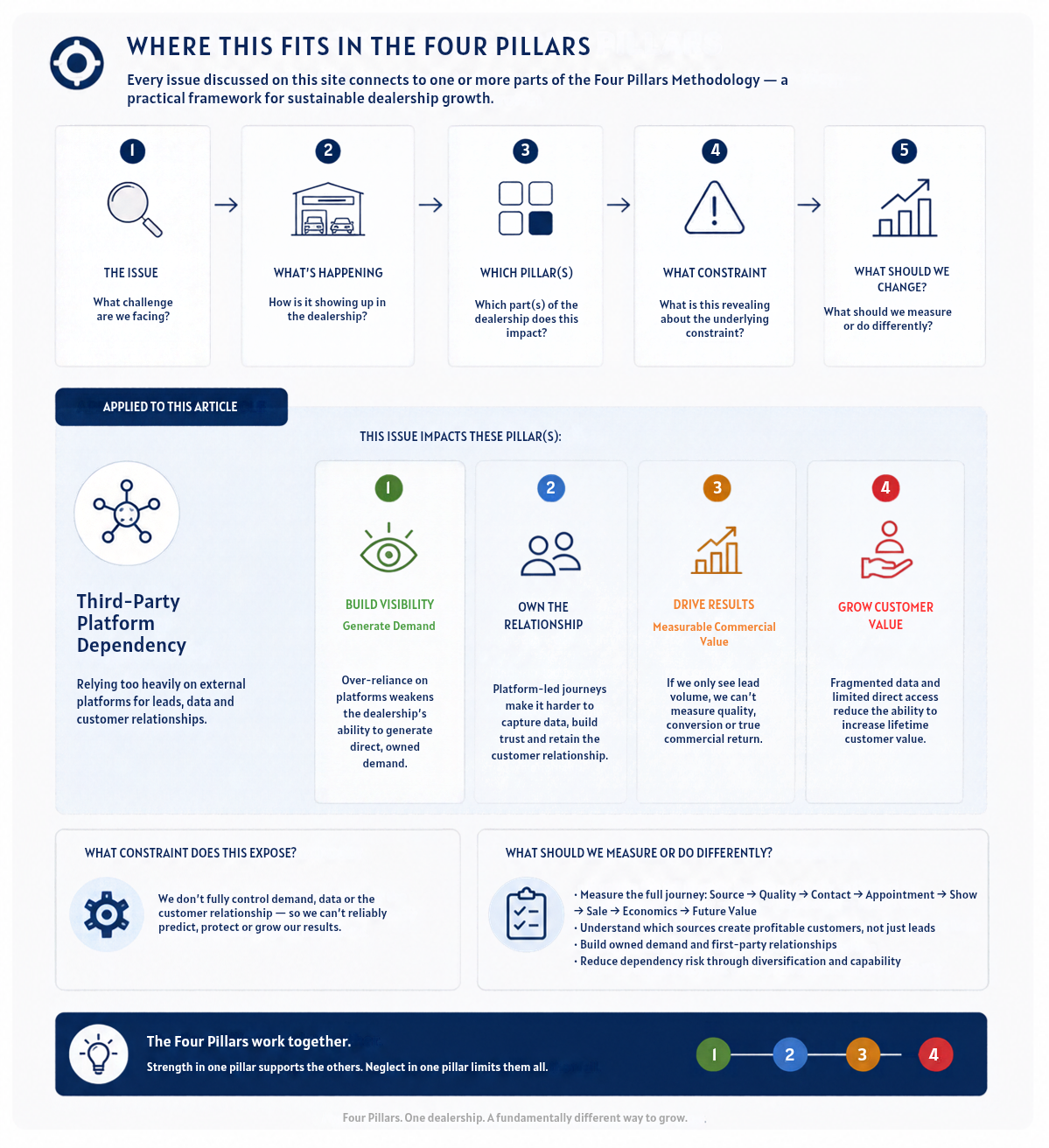
Third-party platform dependency is not a separate marketing problem. It runs through all four pillars of dealership growth.
The question for a Dealer Principal is not whether third-party platforms should be used.
It is whether the dealership is using them from a position of strength — or whether the dealership has become dependent on them to create the demand, data and relationships it needs to grow.
Where this fits into the Four Pillars
Your CRM Knows the Customer’s Preferences. Does Your Dealership?

Why Dealer Websites Need to Prioritise First-Party Lead Capture in 2026
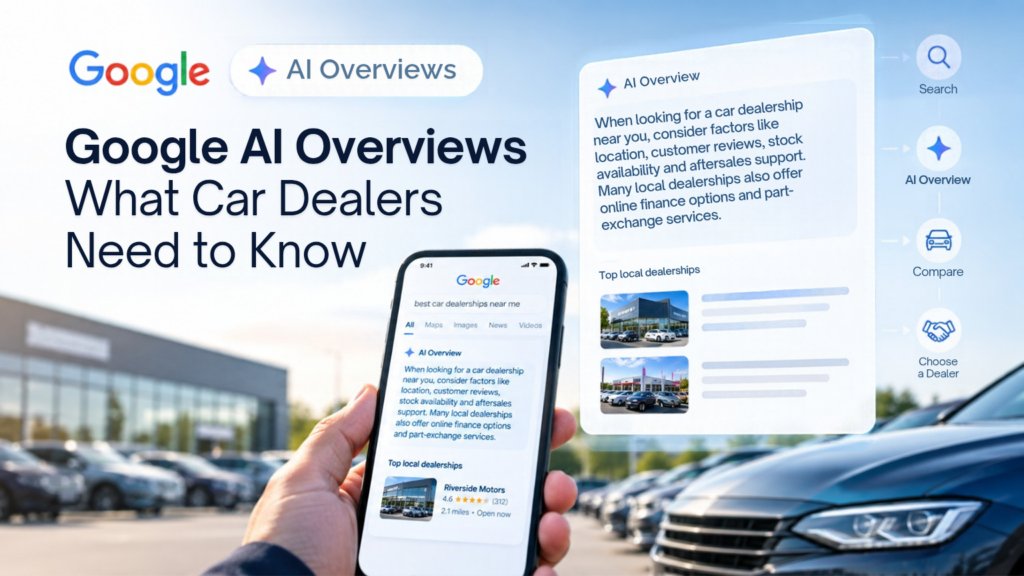
Google AI Overviews Are Changing How Car Buyers Find Dealerships — Here’s What to Do About It

Google Business Profile for Car Dealers: A Practical Guide for UK Franchised Main Dealers
Leave a Reply