

A Google Business Profile is often one of the first places a customer encounters a dealership while researching a car, checking opening hours, looking for directions or deciding whether to make contact.
For privately-held and family-owned franchised main dealers, the opportunity is straightforward: make it easy for customers to find accurate information, assess the dealership and take the next step.
But a profile is not a magic ranking switch. Nor is there evidence that it guarantees visibility in Google’s AI-generated answers. It is one part of a wider digital strategy for franchised main dealers—and it works best when the information is accurate, the customer experience is credible and the results are measured properly.
What Google Business Profile can—and cannot—do
Google says local results are mainly based on relevance, distance and prominence (Google’s local ranking guidance). Complete and accurate profile information helps Google understand a business and match it to relevant searches. Google also identifies reviews and links among the information that can contribute to prominence.
That is useful guidance, but it is not a complete ranking formula. Google does not publish every detail of its systems, and no profile change guarantees a particular position.
For a dealership, the practical objective is not to chase a supposed secret ranking factor. It is to make the profile accurate, helpful and consistent with the real business.
Start with the essentials:
- Confirm the dealership name, address, phone number, website and opening hours.
- Check holiday hours and other temporary changes when relevant.
- Make sure the map pin and directions take customers to the right entrance or site.
- Select the most accurate primary business category and appropriate additional categories from those Google actually makes available.
- Review the business description for clear, factual information about the dealership.
- Check that the profile represents the real-world business and follows Google’s Business Profile guidelines.
Do not add keywords to the business name unless they are genuinely part of the real-world name. Do not create duplicate profiles to target nearby towns or search phrases. Shortcuts that conflict with Google’s rules can create more problems than they solve.
Build Visibility: make the profile useful to a real car buyer
Build Visibility is the first of the Four Pillars of Dealer Growth. For a Business Profile, that begins with helping a customer recognise that the dealership is relevant to their needs and giving them reliable information once they find it.
Use categories and descriptions accurately
Categories should describe what the dealership is, not act as a list of keywords. Review the options available in the profile and choose those that accurately represent the business.
Use the description to explain the dealership clearly. Depending on the site, that may include the franchise represented, new and used vehicle sales, servicing, parts or other genuine activities. Keep it factual and readable. Avoid promotional claims that cannot be substantiated, and do not treat the description as a place to repeat every keyword you want to rank for.
Add relevant, high-quality photos
Photos help customers understand what to expect before they visit. Use clear, current images that represent the actual dealership: the exterior, showroom, forecourt, service reception, facilities and team where appropriate.
For vehicle imagery, make sure photographs are genuine and accurately represent the vehicles being advertised. Keep images current and remove content that is no longer representative.
The point is usefulness, not volume for its own sake. No unverified engagement statistic is needed to justify showing customers what the dealership looks like. Use photos because they help people make a more informed decision.
Publish updates when there is something worth saying
Google Business Profile posts can be used to communicate updates, offers, events and other timely information, where those features are available. A post may include text, imagery and an action button, subject to Google’s post guidance.
Use that space when the dealership has something useful to communicate: a genuine event, a relevant service update, a seasonal opening-hours change or an offer with clear terms and dates.
Do not assume that posting a set number of times each week automatically improves local rankings. Google’s published guidance does not establish a universal posting frequency as a ranking factor. Prioritise accuracy, relevance and a clear next step for the customer.
Keep vehicle inventory claims precise
Google documents vehicle inventory features for eligible dealerships, but availability can be limited and programme-specific. Organic vehicle listings should not be confused with paid Vehicle Ads in Google Ads; they are distinct products with different requirements.
Before building a process around a particular inventory feature, confirm that it is currently available to the dealership in the UK and that the business or its provider meets the relevant eligibility and technical requirements. Do not assume every UK dealer can activate the same feature simply because it appears in documentation or in another market.
Whatever the channel, vehicle details on the profile, website and advertising should be accurate and kept up to date. A customer who finds a vehicle that is no longer available has not had a good digital experience.
Own the Relationship: earn trust before the customer contacts you
Own the Relationship is the second pillar most directly connected to Business Profile management. A profile may help a customer discover the dealership, but the information and experience around it influence whether they feel confident taking the next step.
After 27 years in the motor trade, one distinction is clear to me: a phone enquiry and a website enquiry are not the same conversation. A caller is already trying to speak to someone; a web lead can sit in a queue unless ownership and follow-up are clear. The dealership needs a process for answering or returning calls promptly, recording what the customer needs, and making sure the next action is owned. A profile can help generate the contact, but it cannot make that process work.
Ask for genuine reviews—and respond properly
Reviews are public feedback, not a script for manufacturing a perfect reputation. Google allows businesses to ask customers for reviews, but incentives in exchange for reviews and attempts to manipulate ratings are prohibited (Google’s review guidance).
Build a straightforward process for inviting genuine feedback from customers. Do not offer discounts or gifts for reviews, selectively pressure only happy customers, or write reviews on customers’ behalf.
Respond in a professional and useful way. Thank customers for positive feedback. Where a review raises a concern, acknowledge it without disclosing private customer information and offer an appropriate route to resolve the issue.
Avoid treating review count, recency or sentiment as a simple ranking formula. Google says reviews can contribute to prominence, but that does not justify claiming that one review characteristic universally outweighs another.
Reviews also matter beyond the profile itself. A YouGov Profiles analysis published in May 2023 reported that 57% of British consumers surveyed said they checked written consumer reviews when researching a car. That is automotive research behaviour, not evidence that reviews on Google alone determine a purchase or ranking. It is a reminder that reputation is part of the wider research process.
Keep customer information consistent
Customers may move between Google Search, Maps, a dealership website, a manufacturer website and vehicle marketplaces while comparing options. Information should not contradict itself across those touchpoints.
Check that opening hours, contact details, directions and the destination website are correct. If a customer clicks through to find out more about a vehicle, service or offer, the landing page should answer the question clearly and reflect what the profile promised.
A profile is not a substitute for a useful dealership website or a well-managed enquiry process. It is a point in the journey. The next step needs to work, too.
Understand Q&A and emerging AI features
Google’s current Business Profile Q&A update still describes a Questions and Answers feature, with availability and functionality that can vary by region or business category. Check the live profile and current Google guidance rather than relying on older articles or screenshots that may describe a different interface.
Google Maps has also introduced Ask Maps, a conversational AI feature designed to help people explore places and get answers to questions. Its rollout and individual capabilities have evolved over time. It should be treated as an emerging Maps experience—not as proof that Business Profile Q&A has been universally replaced, or that every feature is available to every UK user.
The practical response for a dealership is less complicated than predicting every interface change: keep core business information accurate, answer customers clearly wherever Google provides a supported way to do so, and monitor the features actually available on the dealership’s own profile.
What Google says about AI Overviews—and what it does not say
Google’s published guidance for AI features in Search says that established SEO best practices remain relevant and that there are no additional technical requirements or special schema needed to appear in AI Overviews or AI Mode. Google also recommends keeping Business Profile information up to date.
That is the defensible position. A Business Profile is not a magic data feed that forces AI to recommend a dealership. See the guide to Google AI Overviews for car dealers for the wider Search context. Google’s guidance does not establish a special direct-feed relationship with Gemini or AI Overviews, and it does not mean a dealership can guarantee inclusion by adding a particular field, publishing more posts or applying special schema.
The sensible approach is to maintain the fundamentals:
- Keep the Business Profile complete and accurate.
- Make the dealership website useful, accessible and crawlable.
- Publish clear information about the business and the services it genuinely provides.
- Ensure important facts agree across the profile and website.
- Measure actual customer actions rather than assuming AI visibility from a tool’s mention or screenshot.
AI-driven local discovery is developing, and research is beginning to measure how consumers use these tools. Yext’s June 2026 survey of 600 UK consumers reported that 36.7% had used AI for local search in the previous month. This is general local-search data, not automotive-specific research; it does not show how many car buyers used AI to choose a dealership, nor does it prove that updating a Business Profile caused an AI recommendation.
The implication is to stay prepared without confusing a developing behaviour with a proven ranking strategy.
Measure actions, not vanity metrics
Google Business Profile Performance reporting can report activity such as searches, profile views and customer interactions, although the available metrics vary. Some reporting may combine data from organic Google surfaces and Google Ads, so it should not automatically be interpreted as a pure measure of unpaid profile performance.
Use these figures as signals, not as the final commercial result.
A practical measurement routine should connect three layers:
1. Profile activity: available searches, views and customer interactions. 2. Customer actions: calls, website visits, direction requests, form submissions and enquiries, using the tracking available to the dealership. 3. Commercial outcomes: qualified opportunities, appointments, showroom visits, orders and sales, where these can be reliably connected.
The third layer is where dealership context matters. A rise in profile views is not necessarily a rise in profitable business. A change in calls may reflect seasonality, stock, opening hours, advertising or other factors—not just a profile edit.
For example, compare weekly direction-request trends with showroom visits and appointments over the same period. Treat that as a relationship worth investigating, not proof that each direction request became a visit. For identifiable enquiries, use call tracking and consistent CRM source/outcome fields to follow the journey from contact to appointment and sale where the data allows.
Use consistent reporting periods, annotate significant changes and compare the profile data with website analytics, call tracking and CRM records where available. Be clear about attribution limits. If the systems cannot reliably connect a profile interaction to a sale, report that limitation rather than claiming certainty.
A practical monthly Business Profile check
A monthly review can be simple and useful. Assign an owner and work through the following:
- Business name, address, phone number, website and opening hours are accurate.
- Categories and description reflect the real dealership.
- Map pin, directions and contact routes work correctly.
- Photos are current, relevant and representative.
- Posts or updates are current where they are being used.
- New reviews are monitored and answered appropriately.
- Any Q&A or other customer-facing features are checked where available.
- Vehicle information and links do not mislead customers about availability.
- Performance metrics are reviewed alongside analytics, calls, CRM and sales data.
- Any significant changes or unexplained movements are recorded for follow-up.
This checklist is a management routine, not a claim that Google requires monthly updates or rewards a particular schedule.
The role of Business Profile in the Four Pillars of Dealer Growth
Google Business Profile is most directly connected to Build Visibility: helping customers discover the dealership and find accurate local information.
It also supports Own the Relationship by presenting a credible business, making contact easier and giving the dealership a place to respond to public feedback.
It contributes to the wider framework, but it cannot deliver the other pillars alone:
- BUILD VISIBILITY — Generate Demand: make the dealership discoverable and the information useful.
- OWN THE RELATIONSHIP — Retain Every Opportunity: create clear routes from discovery to contact, and handle feedback professionally.
- DRIVE RESULTS — Measurable Commercial Value: connect activity to enquiries and commercial outcomes where tracking allows.
- GROW CUSTOMER VALUE — Today & Tomorrow: use the profile as one touchpoint in a longer customer relationship, not as a replacement for the dealership’s wider retention and customer-care work.
The objective is not to make Google Business Profile the whole marketing strategy. It is to make it a dependable part of a dealership’s digital presence—one that supports visibility and trust without creating new unsupported assumptions about rankings or AI.
For privately-held and family-owned franchised main dealers, that discipline matters. It is part of the wider issue of third-party platform dependency. You do not need to believe every new ranking theory or chase every emerging feature. You need accurate information, a useful customer experience and measurement that helps you decide what is worth improving.
About Graham Lower
Your CRM Knows the Customer’s Preferences. Does Your Dealership?

Why Dealer Websites Need to Prioritise First-Party Lead Capture in 2026
The Hidden Cost of Third-Party Platform Dependency for Car Dealers
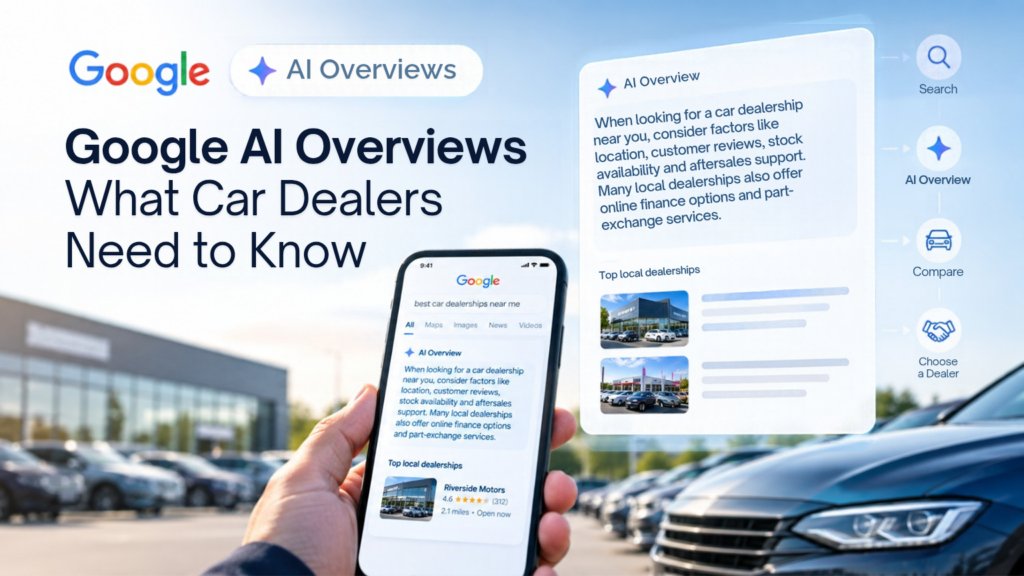
Google AI Overviews Are Changing How Car Buyers Find Dealerships — Here’s What to Do About It

Leave a Reply