
You don’t need the AM100’s budget to compete with the AM100. Your size can actually be your advantage.
If you’re a privately-held or family-owned franchised main dealer, you probably can’t outspend the biggest dealer groups.
And I don’t think you should try.
They have scale. Bigger teams. Bigger budgets. More rooftops. More resources.
So beat them somewhere else.
Move faster. Make decisions faster. Test ideas faster. Find opportunities and act on them before they’ve finished discussing them.
That’s the advantage of being smaller.
Your size is your strength.
And your digital strategy should be built around it.
So how do you compete?
For me, it comes down to four things:
BUILD VISIBILITY.
Generate Demand.
OWN THE RELATIONSHIP.
Retain Every Opportunity.
DRIVE RESULTS.
Create Measurable Commercial Value.
GROW CUSTOMER VALUE.
Today & Tomorrow.
These are my Four Pillars of Modern Dealer Marketing.
They’re not four services.
They’re the way I believe a privately-held and family-owned franchised main dealer should approach digital growth.
01 — BUILD VISIBILITY
Generate Demand
If your customers can’t find you, it doesn’t matter how good your dealership is.
But being found today means more than ranking on Google.
Your customers are researching vehicles, dealerships, prices, finance, reviews and ownership questions across an increasingly fragmented digital journey.
And that journey is changing again.
Google is expanding AI-powered experiences in Search, including AI Overviews and AI Mode. Google’s own guidance says the fundamentals haven’t changed: sites still need to be crawlable, understandable, useful and genuinely valuable to users. It also stresses original, non-commodity content and first-hand expertise.
That’s important.
Because I don’t believe AI search means throwing away SEO and chasing the latest acronym.
It means getting the fundamentals right — and building something worth finding.
That means SEO.
PPC.
Local SEO.
Content.
AEO.
GEO.
Structured data.
Entity understanding.
And increasingly, visibility across AI-powered search, including Google AI Overviews.
But the objective isn’t to tick off a list of marketing channels.
It’s to be visible when the right customer is looking for what you sell, where you sell it and the questions they need answered before they buy.
02 — OWN THE RELATIONSHIP
Retain Every Opportunity
I’m not going to tell you to stop using Auto Trader.
That would be ridiculous.
Third-party platforms can be incredibly valuable.
The question isn’t whether you should use platforms like that.
The question is how dependent you are on them.
If your customer acquisition strategy relies almost entirely on someone else’s audience, platform, data or rules, what happens when those rules change?
Your dealership needs digital assets and customer relationships that you actually own.
Your website.
Your content.
Your first-party customer relationships.
Your local search visibility.
Your brand.
Your reputation.
Because a click isn’t the asset.
The customer is.
03 — DRIVE RESULTS
Measurable Commercial Value
This is where I think digital marketing often gets lost.
Traffic.
Clicks.
Impressions.
Rankings.
They can all be useful.
But they’re not the reason you’re spending money.
You want customers.
You want enquiries.
Test drives.
Vehicle sales.
Aftersales opportunities.
Repeat business.
And ultimately, a return on the investment you’re making.
So I don’t want to build a strategy around making a marketing dashboard look impressive.
I want to know:
What’s working?
What’s not?
Where is the opportunity?
And what should we do next?
Because you don’t need more marketing activity.
You need better decisions.
04 — GROW CUSTOMER VALUE
Today & Tomorrow
Winning the customer is only the beginning.
A customer who buys a car from you today could generate value through servicing, MOT, parts, aftersales, another vehicle purchase and referrals for years.
That’s why digital marketing shouldn’t simply be about generating the next enquiry.
It should help you build relationships that create value beyond the first transaction.
The objective isn’t simply to win today’s customer.
It’s to grow the value of every customer your dealership earns.
What about SEO, PPC, AEO, GEO and AI?
They’re tools.
They’re disciplines.
They’re ways of approaching different parts of the modern search environment.
But none of them is a magic bullet.
Google’s current guidance is particularly important here. Google continues to emphasise that the fundamentals of SEO remain relevant to its generative AI search experiences.
So I’m not interested in selling you an “AI search hack”.
I’m interested in making sure your dealership is:
Technically sound.
Easy to understand.
Visible locally.
Authoritative.
Useful.
Trusted.
And able to demonstrate genuine expertise.
Then we build from there.
The big groups have advantages. So do you.
I’m not going to pretend the AM100 doesn’t have an advantage.
It does.
Scale matters.
So I’m not telling you:
“The big groups aren’t a threat.”
They are.
I’m telling you:
You don’t have to beat them at being big.
They have scale.
You have agility.
They have bigger teams.
You can make decisions closer to the customer.
They have bigger budgets.
You can make yours work harder.
And when a new opportunity appears, you don’t necessarily need three meetings, a presentation and board approval before you can act.
You can just do it.
That’s your advantage.
I’ve been on both sides of this fight
I’m not saying this as someone who has spent 27 years watching the motor trade from the outside.
I’ve spent 27 years in the motor trade.
I’ve sold cars. Managed sales teams. Worked with manufacturers. Managed dealerships.
Eventually, I became a General Manager in the US.
At Herb Chambers Volvo Cars Norwood, I helped take the dealership from 22nd to #1 in regional new-vehicle sales volume in just 16 months, taking the #1 position from Boston Volvo Cars, a dealer that had held it for decades.
Later, I became General Manager of Boston Volvo Cars.
And I helped them regain the number-one position, increasing sales volume by more than 30% in a market that had grown by just 4%.
So I’ve genuinely been on both sides of the fight.
I’ve taken #1 away.
And I’ve helped take it back.
That’s a big part of why I believe that size doesn’t automatically determine who wins.
Strategy does.
So what does your dealership actually own?
That’s the question I’d start with.
How visible are you in your market?
How much demand are you capturing?
How dependent are you on third-party platforms?
How well does Google understand your dealership?
How well does your website answer the questions your customers are asking?
How visible are you becoming in AI-powered search?
And, most importantly:
Are you building something that creates value for your dealership tomorrow — or simply buying another month’s worth of clicks today?
Because the goal isn’t simply to be visible.
It’s to build an advantage.
Your size is your strength.
The AM100 has scale.
You have agility.
They may have bigger budgets.
You can make better use of yours.
They may have larger marketing departments.
You can move faster.
They may have more resources.
You can stay focused.
You don’t need to be bigger.
You need to be better.
And that’s what I’m on a mission to help you do.
Beat the AM100 — without trying to become them.
Frequently Asked Questions
Can a privately-held or family-owned dealership really compete with an AM100 group?
Yes — but not by trying to outspend one. Larger groups have genuine advantages through scale, resources and purchasing power. A smaller dealership can compete by using advantages such as agility, speed of decision-making, local market knowledge and the ability to act quickly on opportunities.
Do I need a large digital marketing budget to compete?
No. A larger budget can buy more exposure, but spending more money does not automatically create a better strategy. The objective is to make your available budget work harder by concentrating it on the channels, customers and opportunities that can create measurable commercial value.
Does SEO still matter now that customers are using AI search?
Yes. Google’s current guidance makes clear that the fundamental principles of SEO remain relevant to AI-powered search experiences. Crawlability, clear site structure, useful content, technical quality, first-hand expertise and making your business understandable to search systems remain important foundations.
Should dealerships stop using Auto Trader and other third-party platforms?
No. Third-party platforms can be extremely valuable sources of demand. The issue is dependence, not usage. A strong strategy should use valuable external channels while also building digital assets, visibility and customer relationships that the dealership actually owns.
What does “own the relationship” actually mean?
It means retaining as much control as possible over the customer relationship and the digital assets that generate demand. Your website, brand, content, local search presence, first-party customer relationships and customer data are assets that can continue creating value for your dealership rather than existing entirely on someone else’s platform.
What does your Four Pillars approach actually focus on?
It focuses on four connected outcomes: building visibility, owning the relationship, driving measurable results and growing customer value; whilst also reducing dependency on third-party platforms; SEO, PPC, local search, content, AEO, GEO, AI search and other digital disciplines sit underneath those pillars rather than being the objective themselves.
Why focus specifically on privately-held and family-owned franchised main dealers?
Because that is where I believe my experience and approach can create the most value. I understand the motor trade from the inside, and I believe privately-held and family-owned franchised main dealers can use their agility, focus and local knowledge to compete effectively against much larger groups.
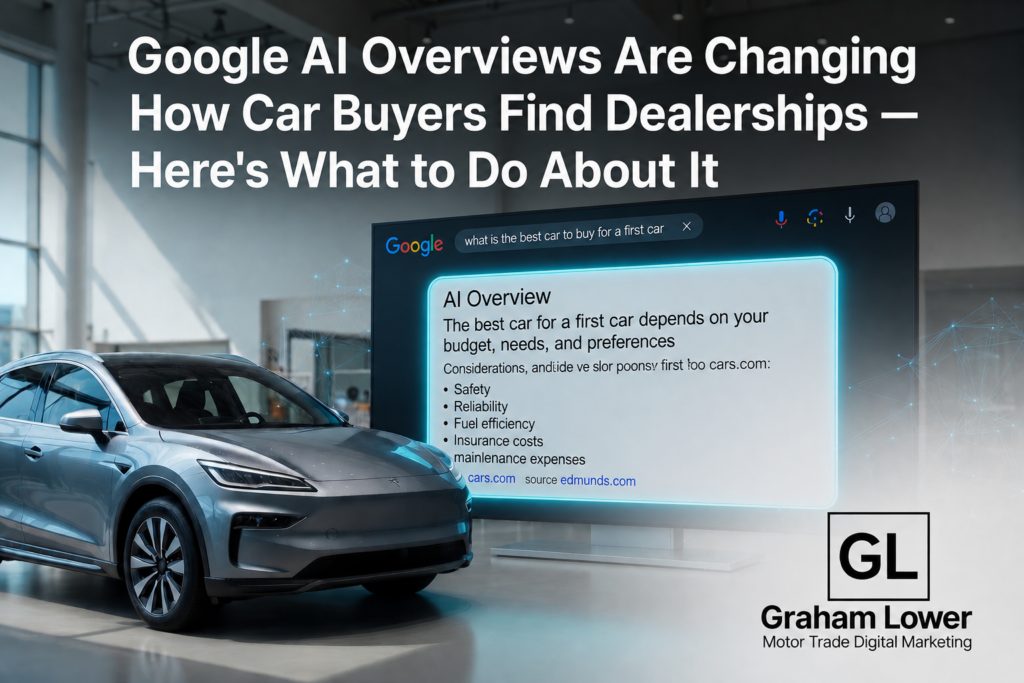
Google AI Overviews Are Changing How Car Buyers Find Dealerships — Here’s What to Do About It
Leave a Reply