
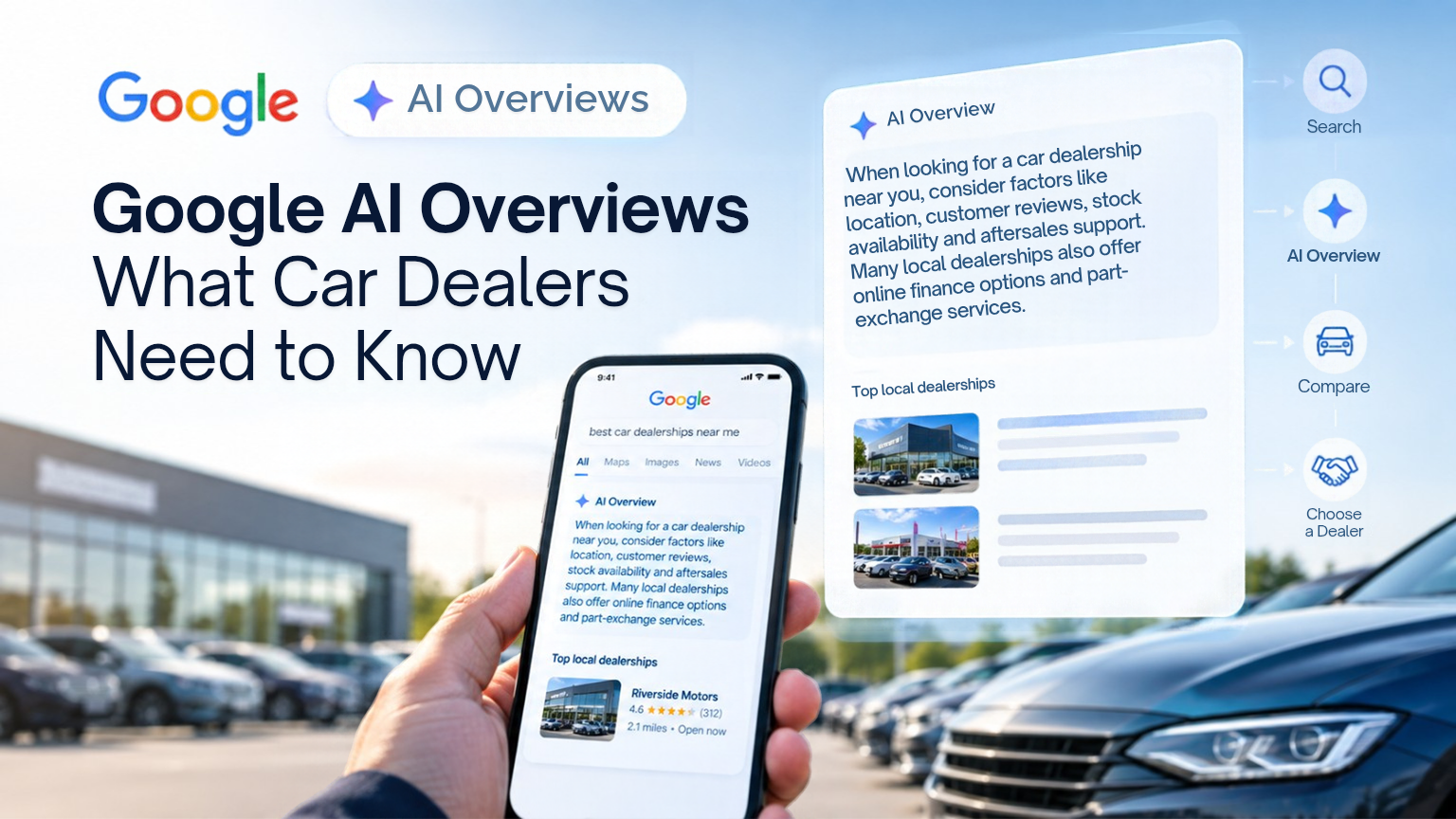
Google is changing how people find information before they buy a car.
AI Overviews can now answer many research questions directly within Google Search, before a customer reaches a dealership website.
For a dealer principal, the important question isn’t whether AI is replacing SEO.
It isn’t.
The question is whether your dealership is still visible when a potential customer is researching what to buy, comparing options and deciding which businesses to trust.
That is a much bigger issue than rankings.
The short answer
Google AI Overviews generate AI-powered summaries within Search, drawing on information from multiple sources.
They are particularly relevant to informational and research-led searches.
That matters to car dealers because the buying journey often starts long before a customer submits an enquiry.
A customer might first search:
- Is a hybrid better than an electric car?
- Is PCP better than HP?
- Is an Approved Used car worth paying more for?
- What should I check when buying a used car?
- How much does it cost to run an electric car?
- Which SUV is best for a family?
If Google answers those questions without the customer visiting your website, your dealership can lose an opportunity to become part of the buying conversation.
The answer isn’t to publish hundreds of AI-generated articles.
It is to make your dealership’s genuine knowledge easier to discover, understand and trust.
That starts with answering the questions your customers actually ask.
Why AI Overviews matter to franchised dealers
The traditional dealership website has largely been built around transactional intent.
New cars.
Used cars.
Finance.
Part exchange.
Servicing.
Contact us.
Those pages still matter.
But they don’t represent the entire buying journey.
A customer can spend days or weeks researching a vehicle before they ever search for a dealership.
During that period they are asking questions.
They’re comparing models.
They’re trying to understand finance.
They’re looking at ownership costs.
They’re deciding whether an electric vehicle makes sense.
They’re looking for reassurance.
They’re forming opinions.
By the time they search for:
“BMW dealer near me”
or
“Toyota Yaris for sale”
they may already have a strong preference.
The dealership that helped them reach that decision has already earned something valuable.
Attention.
Trust.
And potentially the opportunity to influence the purchase.
That is why AI search matters.
It moves part of the competition further upstream in the customer journey.
AI Overviews don’t mean SEO is dead
This is where some of the commentary around AI search goes wrong.
AI Overviews haven’t made traditional SEO irrelevant.
Google’s own guidance is clear: websites do not need a separate technical optimisation system for AI Overviews or AI Mode. The fundamentals still matter — useful content, crawlability, internal links and structured data that accurately reflects the visible page content.
The change is in how visibility can happen.
Previously, the objective might have been:
Rank → get the click → get the visitor.
Now there is another possibility:
Answer → get cited → become visible → earn the next interaction.
That doesn’t make the website less important.
It makes the quality and usefulness of the information on it more important.
The click is no longer the whole story
That matters because the click is no longer the whole story.
Ahrefs’ research found that when an AI Overview appeared, the average click-through rate for the top-ranking result was 58% lower in its later study of informational searches. That is not a forecast of a 58% fall in dealership enquiries, and the research was not specific to automotive. It does, however, show why visibility inside the search result itself is becoming commercially important.
For a dealer, the question is no longer simply: “Did we rank?”
It is also: “Was our dealership, our expertise or our answer visible when the buyer asked the question?”
They aren’t dealer-specific.
They are evidence of a wider change in search behaviour.
The more important point is this:
Ranking highly does not automatically mean you receive the same value from that visibility as you did before.
If Google can answer the question before the click, the value of the click changes.
That means dealers need to think beyond traffic.
What happens before the customer becomes a lead?
Where did the customer first encounter your business?
Did your dealership influence the research?
Did they return to your website?
Did they give you permission to continue the relationship?
Did they eventually enquire?
And, ultimately, did that opportunity become a sale?
That’s where AI visibility becomes a dealer-growth issue rather than simply an SEO issue.
Answer the question before you sell the car
There is a simple principle behind much of what works in AI-mediated search:
Answer first. Explain second. Sell later.
Imagine a customer searches:
“Is PCP better than HP?”
A traditional dealership page might begin:
Welcome to ABC Motors. We’ve proudly served motorists in the local area for more than 40 years…
That may be perfectly acceptable brand copy.
But it isn’t the answer.
A stronger opening would be:
PCP is usually more suitable for drivers who want lower monthly payments and the option to change their car at the end of the agreement. HP is generally more straightforward for buyers who want to own the vehicle once the finance has been paid.
Now the customer has an answer.
The rest of the page can explain the differences, advantages, disadvantages and situations where each option may make sense.
That’s better for the customer.
It also creates a much clearer piece of information for search systems to understand.
This is what I mean by answer-first content.
It isn’t about writing for robots.
It is about writing the way a good salesperson actually answers a customer.
Your dealership already has the content
This is where I think many franchised dealers are missing an opportunity.
You don’t need an AI content factory.
You need to extract the knowledge already sitting inside your business.
Your sales managers hear the same questions every week.
Your business managers explain finance options every day.
Your technicians know which ownership problems customers actually encounter.
Your aftersales team knows what owners worry about.
Your salespeople know which objections stop customers buying.
That knowledge is valuable.
And unlike generic manufacturer copy, it is difficult for every competing dealership to reproduce.
Consider questions such as:
- Is an electric vehicle suitable for someone who regularly drives long distances?
- What happens if I want to part-exchange a car with outstanding finance?
- Is an Approved Used vehicle worth paying more for?
- What should I look for when buying a used car?
- How much does it really cost to run a hybrid?
- What happens when a PCP agreement ends?
- Should I buy now or wait?
- What are the most common mistakes people make when choosing a family SUV?
Those aren’t just keyword opportunities.
They are conversations already happening in your showroom.
Turn those conversations into useful content.
Stop publishing digital brochures
One of the biggest problems I see with dealership websites is that they still behave like digital brochures.
Manufacturer specifications.
Stock.
Offers.
Finance promotions.
“Why choose us?”
“Excellent customer service.”
“Trusted local dealership.”
There is nothing inherently wrong with any of that.
But almost every competing dealership can say the same thing.
And manufacturer websites often have considerably more authority for manufacturer-controlled information.
Your advantage is different.
You know your customers.
You know the questions they ask.
You know the objections.
You know what happens after someone buys the car.
You know what ownership actually looks like.
That is where original dealership content can become commercially useful.
The objective isn’t to produce more content than the AM100.
It is to produce information that a customer actually wants from your dealership.
Don’t confuse AI visibility with AI-generated content
This distinction matters.
There is a temptation to think:
AI search is growing → therefore we need AI-generated content.
I think that’s backwards.
The opportunity is to use technology to make genuine expertise more accessible.
Google’s current guidance explicitly focuses on the value and purpose of content rather than rewarding content simply because it was or wasn’t produced with AI. It also warns against scaled content production where automation is being used primarily to manipulate search rankings.
For a dealership, the strongest model is therefore:
Human expertise → useful answer → evidence and explanation → structured website → ongoing relationship.
AI can help with the production process.
It shouldn’t become the source of the dealership’s expertise.
Build a library of customer questions
One article won’t transform a dealership’s visibility.
A connected body of useful information can.
Imagine a dealership sells Volvo.
Instead of producing one generic “Volvo XC60 Review”, build a useful collection around the questions customers actually ask:
- Is the Volvo XC60 reliable?
- What does a Volvo XC60 cost to run?
- Is the XC60 suitable for a family?
- Volvo XC60 versus BMW X3
- Volvo XC60 versus Audi Q5
- Should I buy a new or Approved Used XC60?
- What should I check when buying an XC60?
- Which XC60 engine is right for me?
- What does servicing an XC60 cost?
- Common XC60 ownership questions
Now the dealership isn’t simply publishing pages.
It is building a body of knowledge.
And those pages can support each other through internal links.
That creates a much stronger digital asset than a collection of disconnected blog posts.
Internal linking matters more than another 500 words
If a customer reads an article about PCP and your website has a useful finance calculator, relevant vehicle pages and another article explaining what happens at the end of a PCP agreement, those resources should connect.
The customer shouldn’t have to return to Google to find the next answer.
This is one of the simplest ways to turn informational content into something commercially useful.
The journey becomes:
Question → answer → deeper information → vehicle consideration → dealership interaction.
That is far more valuable than simply measuring whether somebody landed on an article.
What about structured data and schema?
There is no special schema markup that guarantees inclusion in Google AI Overviews.
Use structured data where it genuinely describes the page — and make sure it matches the visible content. Do not add schema simply because you want Google or an AI system to understand a claim that the page itself does not clearly support.
Google’s current guidance on optimising for generative AI features makes this distinction particularly important.
The order matters:
Useful content first.
Clear structure second.
Technical understanding third.
Not the other way around.
The order matters:
Useful content first.
Clear structure second.
Technical understanding third.
Not the other way around.
The biggest opportunity for privately-held and family-owned dealers
This is where AI search connects directly with dealer strategy.
Large groups can buy visibility.
They can spend more.
They can operate at enormous scale.
A privately-held or family-owned franchised dealer doesn’t necessarily win that battle by trying to become a smaller version of a large group.
The advantage is different.
You can be closer to the customer.
You can move faster.
You can use the experience inside your business.
You can create content based on real conversations rather than corporate templates.
And you can build a relationship with the customer rather than simply renting access to them through a third-party platform.
That is a much bigger opportunity than “getting into AI Overviews”.
This is why the answer is not simply to spend more. It is to build a better digital strategy — one that connects visibility, customer relationships and measurable commercial value.
AI search is part of a bigger dealer-growth problem
This is why I don’t see SEO, AI search, AEO or GEO as separate disciplines.
They are different parts of the same digital visibility problem.
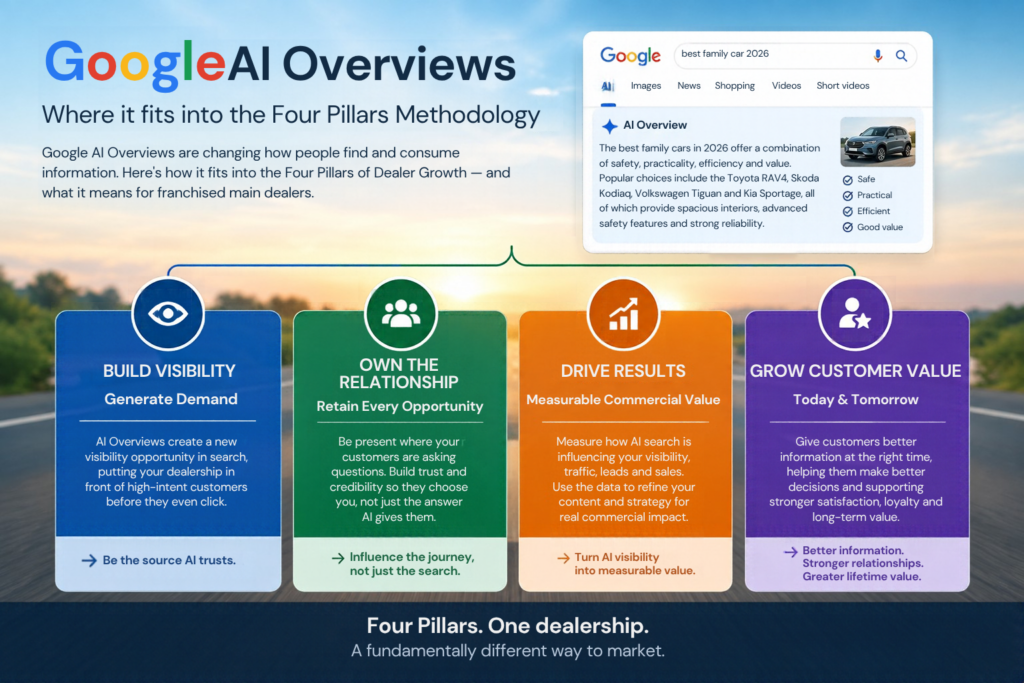
They sit inside the wider Four Pillars of Dealer Growth:
BUILD VISIBILITY — Generate Demand
Be discoverable when customers are researching.
OWN THE RELATIONSHIP — Retain Every Opportunity
Don’t allow every customer interaction to remain dependent on a third-party platform.
This is closely connected to the wider problem of third-party platform dependency — where a dealer can generate visibility and enquiries without necessarily owning the customer relationship behind them.
DRIVE RESULTS — Measurable Commercial Value
Measure more than impressions, clicks and leads. Understand opportunity quality, appointment rates, closing ratios and where the opportunity actually came from.
GROW CUSTOMER VALUE — Today & Tomorrow
A customer who isn’t ready to buy today can still become valuable later if the dealership has earned the relationship and can continue the conversation appropriately.
AI search affects the first pillar.
But its commercial value depends on what happens across all four.
What should a dealer do now?
You don’t need to rebuild your website.
Start with what you already have.
1. Find the questions your customers actually ask
Ask sales, BDC, business managers and aftersales.
Don’t start with a keyword tool.
Start with the showroom.
2. Audit your existing content
Find the pages that already attract search visibility.
Look for pages ranking but not generating meaningful engagement.
Look for important customer questions that your website doesn’t answer.
Then improve the pages that matter most.
3. Rewrite weak introductions
Put the answer near the top.
Don’t make the customer work for it.
4. Replace generic manufacturer copy where you can add genuine value
Specifications belong on the site.
But they aren’t your competitive advantage.
Your experience is.
5. Build connected content
Don’t publish isolated articles.
Create groups of useful answers around vehicles, finance, ownership, servicing and buying decisions.
Then link them together.
6. Strengthen your first-party relationship
A search visitor is not the end goal.
The goal is to turn visibility into a relationship the dealership can continue to develop.
That’s where the website becomes more than a brochure.
It becomes an owned asset.
7. Measure the commercial journey
Don’t stop at:
Impressions → clicks → leads.
Ask:
- Where did the opportunity originate?
- What did the customer consume before contacting us?
- Was an appointment set?
- Did the appointment happen?
- Did it become a sale?
- Did the customer return later?
That is how you start connecting digital visibility with commercial value.
The bottom line
Google AI Overviews are another change in how customers discover information.
They aren’t the death of SEO.
They aren’t a reason to fill your website with AI-generated articles.
And they aren’t something you can solve by adding another piece of schema.
The real opportunity is much simpler.
Become the dealership that answers the questions your customers are already asking.
Use the experience already inside your business.
Make that knowledge easy to find.
Make it easy to understand.
Connect it to the rest of your website.
Then build the relationship beyond the initial search.
For privately-held and family-owned franchised main dealers, that matters because you don’t need the biggest marketing budget to compete.
You need to use your advantages better.
Your experience.
Your agility.
Your customer knowledge.
And your ability to build digital visibility that you actually own.
AI isn’t replacing that expertise.
It is creating another way for customers to discover it.
Where this fits in to the Four Pillars Methodology
About Graham Lower
Your CRM Knows the Customer’s Preferences. Does Your Dealership?
Why Dealer Websites Need to Prioritise First-Party Lead Capture in 2026
The Hidden Cost of Third-Party Platform Dependency for Car Dealers
Google Business Profile for Car Dealers: A Practical Guide for UK Franchised Main Dealers
Leave a Reply