
You don’t need the AM100’s budget to compete with the AM100. Your size can actually be your advantage.
If you’re a privately-held or family-owned franchised main dealer, you probably can’t outspend the biggest dealer groups.
And I don’t think you should try.
They have scale, bigger teams and more resources. But competing effectively doesn’t always mean matching their spending.
It means understanding where your dealership has an advantage — and building a digital strategy around it.
You may be able to make decisions faster, test ideas sooner and act on local opportunities without navigating layers of approval.
Your size is your strength.
The question is whether your digital strategy makes the most of it.
How can a smaller dealership compete?
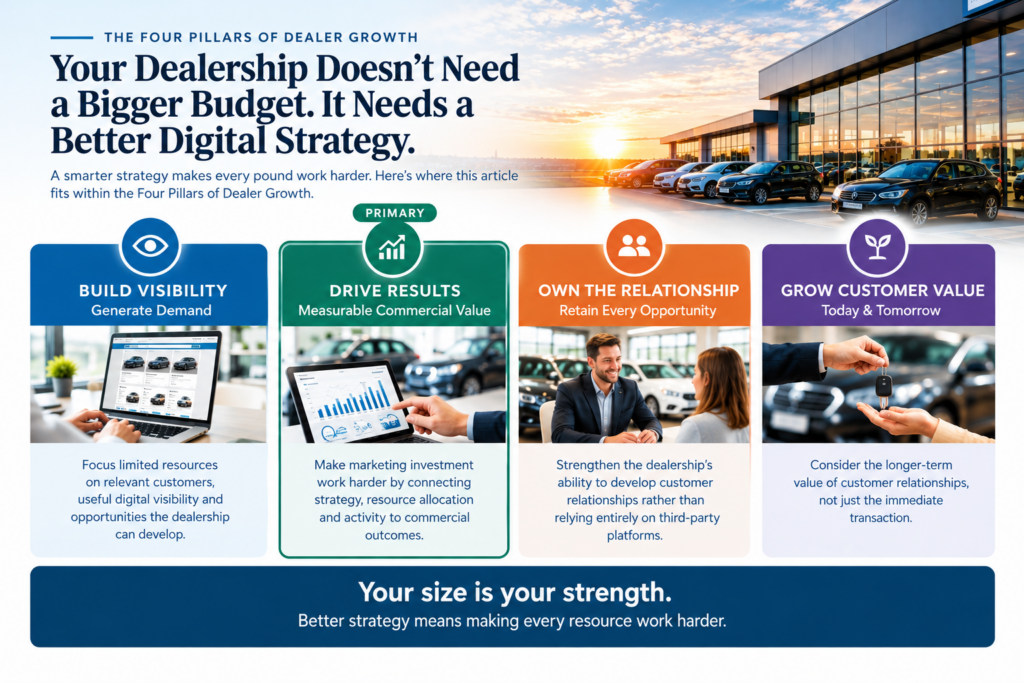
I believe it starts with four connected priorities:
BUILD VISIBILITY
Generate Demand.
OWN THE RELATIONSHIP
Retain Every Opportunity.
DRIVE RESULTS
Measurable Commercial Value.
GROW CUSTOMER VALUE
Today & Tomorrow.
These are the Four Pillars of Dealer Growth.
They aren’t four services or a checklist of marketing channels. They are the strategic principles I’m developing around how privately-held and family-owned franchised main dealers can build stronger, more competitive businesses.
01 — BUILD VISIBILITY
Generate Demand
If customers can’t find your dealership, it doesn’t matter how good it is.
But being found today means more than ranking on Google.
Customers research vehicles, prices, finance, dealerships, reviews and ownership questions across an increasingly fragmented digital journey. Search is changing, too, with AI-powered experiences such as Google AI Overviews and AI Mode.
Google’s own guidance is clear: the established fundamentals of SEO remain relevant. Websites still need to be accessible to Search, and content needs to be useful, reliable and created for people. There are no special optimisation tricks that guarantee inclusion in AI-powered results.
That matters because I don’t believe AI search means throwing away SEO and chasing the latest acronym.
It means getting the fundamentals right — and building something worth finding.
Depending on the dealership and its market, that may involve SEO, paid search, local visibility, useful content, structured data and making the business easier for search systems to understand.
It may also mean improving your Google Business Profile for car dealers and understanding how your website can be discovered through Google AI Overviews and AI-powered search.
These are different disciplines, not a list every dealership should pursue in equal measure.
The commercial question is simpler:
Can the right customer find you when they’re looking for what you sell, where you sell it, or the answers they need before buying?
That is the outcome visibility should support.
02 — OWN THE RELATIONSHIP
Retain Every Opportunity
I’m not going to tell you to stop using Auto Trader.
That would be ridiculous.
Third-party platforms can put your vehicles in front of customers who might not otherwise find you. They can play an important role in generating demand.
The question isn’t whether you should use them.
It’s how dependent your dealership has become on them.
If a large proportion of your customer acquisition relies on somebody else’s platform, audience, pricing or rules, what happens when those change?
Your dealership needs an ecosystem of digital assets and customer relationships that it can continue to develop.
That includes your website, your content, your brand, your local search presence, your reputation and the customer relationships you can lawfully maintain.
It also means thinking about what happens after someone clicks, enquires or visits your website. Can the dealership give that customer useful information, handle the opportunity properly and maintain an appropriate relationship if they aren’t ready to buy today?
The click isn’t the asset. The customer relationship is.
This is why I believe third-party platform dependency deserves to be treated as a commercial consideration, not simply a marketing preference.
The objective isn’t to eliminate external platforms. It is to make sure they support your business rather than becoming your only practical route to demand.
03 — DRIVE RESULTS
Measurable Commercial Value
This is where digital marketing can lose sight of the commercial objective.
Traffic, clicks, impressions and rankings can all tell you something useful. But they don’t, on their own, tell you whether the dealership is getting the value it needs from its marketing.
You want relevant enquiries, appointments, test drives, vehicle sales, aftersales opportunities, repeat business and a return that justifies the investment.
Those outcomes don’t all happen at the same time, and not every sale can be attributed neatly to a single marketing channel.
That makes good measurement more important, not less.
I want to understand:
- What is working?
- What isn’t working as expected?
- Where is the commercial opportunity?
- What is stopping that opportunity from being realised?
- What should we do next?
The answers might point to a visibility problem. They might reveal poor enquiry handling, weak appointment conversion, an unsuitable proposition or a measurement gap.
More marketing activity won’t necessarily solve any of those problems.
Better decisions start with understanding what is actually happening.
The aim is to connect digital activity to commercial outcomes as clearly as the available evidence allows — and to use what we learn to improve the next decision.
04 — GROW CUSTOMER VALUE
Today & Tomorrow
Winning a customer is only the beginning of the relationship.
A customer who buys a car today may return for servicing, MOTs, parts, another vehicle purchase or recommend the dealership to someone else.
That future value isn’t automatic. It depends on the customer’s experience, the relevance of your communications, the quality of your aftersales proposition and whether you give them good reasons to return.
Digital marketing should therefore do more than generate the next enquiry.
Where appropriate, and with the necessary permissions and processes in place, it can support useful ongoing communication and help the dealership maintain relationships beyond the first transaction.
The objective isn’t simply to win today’s customer.
It’s to build a relationship that can continue creating value tomorrow.
What about SEO, PPC, AEO, GEO and AI?
They are tools and disciplines that can support different parts of the customer journey.
None is a magic bullet.
Google’s official guidance on AI features and your website explains that established SEO best practices remain relevant to AI Overviews and AI Mode. Meeting those fundamentals does not guarantee that a page will be included, cited or displayed.
That is why I’m not interested in selling you an “AI search hack”.
I’m interested in making sure your dealership has the right foundations: a technically sound website, useful and understandable content, relevant local visibility, credible expertise and a clear connection between what customers need and what the dealership offers.
Then the next investment should be determined by the opportunity, the constraint and the evidence — not by whichever marketing acronym is getting the most attention.
The big groups have advantages. So do you.
I’m not going to pretend that the AM100 has no advantage.
Scale matters. Larger groups can have greater resources, specialist teams and the ability to spread investment across multiple sites.
But size isn’t the only factor that influences performance.
A privately-held or family-owned dealer may have advantages of its own: local knowledge, shorter decision-making routes, closer customer relationships and the ability to act quickly when an opportunity appears.
Those advantages don’t guarantee success. They do give a dealership something to build on.
You don’t have to beat a bigger group at being bigger.
You need to compete where your own strengths matter.
That means making deliberate choices about where to invest, what to measure and which opportunities deserve attention.
It also means recognising when the constraint isn’t marketing at all. Poor stock availability, slow follow-up, weak appointment handling or an uncompetitive proposition won’t necessarily be fixed by buying more traffic.
A better digital strategy has to take the whole dealership context into account.
I’ve been on both sides of this fight
I’m not saying this as someone who has spent 27 years watching the motor trade from the outside.
I’ve spent 27 years in the motor trade.
I’ve sold cars, managed sales teams, worked with manufacturers and managed dealerships. Eventually, I became a General Manager in the US.
At Herb Chambers Volvo Cars Norwood, I helped take the dealership from 22nd to number one in regional new-vehicle sales volume in 16 months, taking the position from Boston Volvo Cars, which had held it for decades.
Later, as General Manager of Boston Volvo Cars, I helped the dealership regain the number-one position, increasing sales volume by more than 30% in a market that had grown by just 4%.
I’ve experienced the challenge of taking the leading position away from a competitor — and the challenge of winning it back.
Those results don’t mean that one strategy will work in every dealership or market. They do inform how I think about competition, commercial priorities and the importance of making the resources available work effectively.
Size matters. But it doesn’t decide every contest.
What does your dealership actually own?
That’s where I would start.
How visible are you in the market you serve?
How much relevant demand are you attracting — and where does it come from?
How dependent are you on third-party platforms?
How well does your website answer the questions customers ask before they buy?
Can your dealership maintain useful customer relationships beyond the initial enquiry?
And can you connect marketing activity to the commercial outcomes that matter?
Those questions are more useful than simply asking whether you need another campaign or another channel.
Are you building an advantage that can continue creating value — or just buying another month of clicks?
The answer won’t always be the same for every dealership. It should, however, guide where your attention and budget go next.
Your size is your strength
You may not have the biggest budget or the largest marketing department.
But you can make focused decisions. You can use your local knowledge. You can identify constraints and act on opportunities without assuming that the answer is always more spending.
That doesn’t make competing easy. It makes a different approach possible.
You don’t need to become a large dealer group to compete with one.
You need a strategy built around your own strengths.
That is the thinking behind the Four Pillars of Dealer Growth — and the work I’m developing for privately-held and family-owned franchised main dealers.
Compete differently. Build what you can own. Make every decision count.
Frequently Asked Questions
Can a privately-held or family-owned dealership compete with an AM100 group?
Yes, but not by assuming it can match a larger group’s spending or resources. Smaller dealerships may be able to use agility, local market knowledge and closer decision-making to their advantage. The result depends on the market, the dealership’s proposition, its execution and the opportunities available.
Do I need a large digital marketing budget to compete?
No. A larger budget can buy more exposure, but spending more does not automatically produce a better commercial outcome. The priority is to understand where your available budget can make a meaningful difference and whether the dealership is equipped to convert that opportunity.
Does SEO still matter now that customers are using AI search?
Yes. Google’s guidance confirms that the established fundamentals of SEO remain relevant to AI Overviews and AI Mode. Useful content, technical accessibility and a website that can be understood by Search remain important foundations. None guarantees inclusion in AI-generated results.
Should dealerships stop using Auto Trader and other third-party platforms?
No. Third-party platforms can be valuable sources of customer demand. The strategic issue is dependence, not usage. A dealership should understand the role each platform plays while continuing to build its own digital assets and customer relationships.
What does “own the relationship” actually mean?
It means building the practical ability to develop customer relationships over time, rather than relying entirely on a third party to mediate every interaction. That involves useful dealer-controlled digital journeys, appropriate first-party data practices, effective follow-up and a customer experience that gives people reasons to return.
What do the Four Pillars of Dealer Growth focus on?
They provide four connected strategic lenses: building visibility to generate demand, owning the relationship to retain opportunities, driving measurable commercial value and growing customer value over time. Digital channels and technologies support these objectives; they are not the objectives themselves.
Why focus on privately-held and family-owned franchised main dealers?
Because that is where I believe my motor-trade experience and developing approach are most relevant. I understand dealership operations from the inside, and I believe privately-held and family-owned franchised main dealers can use their own strengths to compete differently from larger groups.
Where this fits in to the Four Pillars Methodology
About Graham Lower
Your CRM Knows the Customer’s Preferences. Does Your Dealership?
Why Dealer Websites Need to Prioritise First-Party Lead Capture in 2026
The Hidden Cost of Third-Party Platform Dependency for Car Dealers
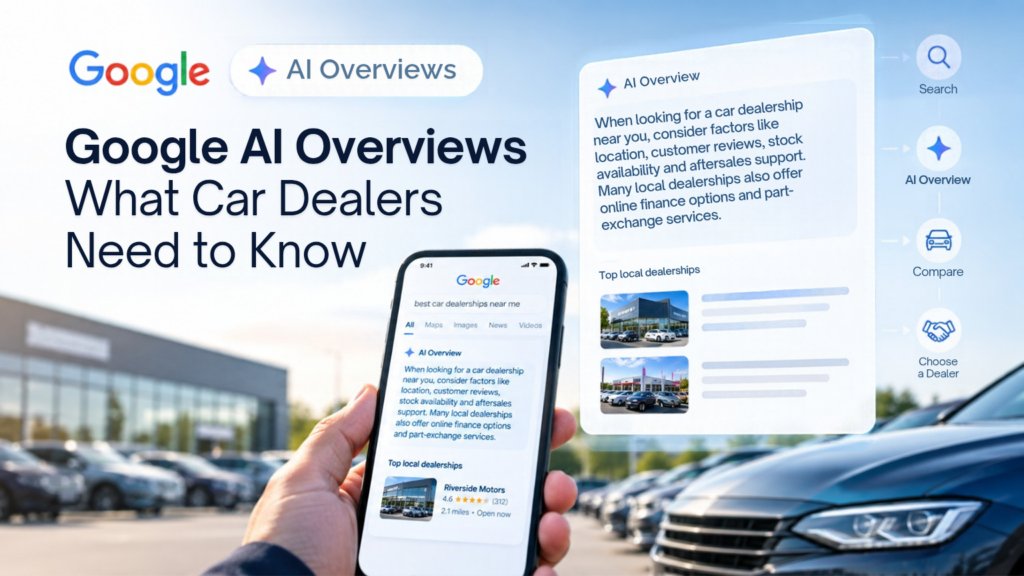
Google AI Overviews Are Changing How Car Buyers Find Dealerships — Here’s What to Do About It
Leave a Reply